Dr. Ratnav Ratan is a pediatric orthopedic surgeon in Gurgaon and Delhi NCR offering treatment to resolve hemihypertrophy of limb conditions in children.
Dr. Ratnav Ratan is known for his passionate approach towards best possible recovery of his patients.
Hemihypertrophy is referred to as overgrowth syndrome or hemihyperplasia.
In this condition, there is uneven growth on both sides of the body, meaning one side of the body registers more growth than the other side.
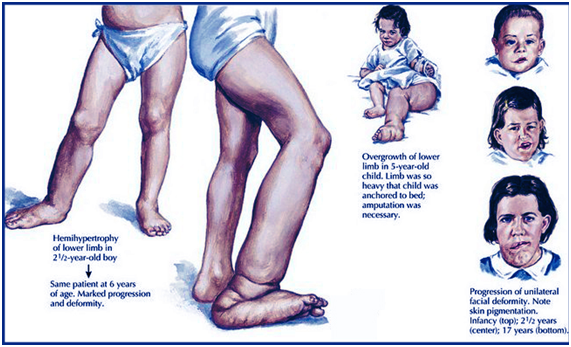
Hemihypertrophy causes unequal growth on one side of the body and may affect limbs and facial features.
Hemihypertrophy condition affects upper and/or lower extremities and facial features.
Children with hemihypertrophy need to be checked for tumors.
Neurofibromatosis type 1 is an autosomal disorder caused by a mutation in the NF1 gene. It can lead to skin lesions, spinal involvement, lower and upper extremity deformities, scoliosis, kyphoscoliosis, congenital bowing, pseudoarthrosis, chest-wall deformities, overgrowth of the extremity, and soft-tissue tumors.
Beckwith-Wiedemann syndrome is a genetic disorder that can be recognised at birth. It may present with hemihypertrophy of a limb, overgrowth of one side or one part of the body, large birth weight and length, hypoglycemia, abdominal wall defects, and an enlarged tongue.
Proteus syndrome is distinguished by overgrowth of bones, skin, muscles, fatty tissues, blood and lymphatic vessels. Children are often born without clear deformity, but asymmetrical growth later becomes visible in the limbs and spine, and may be associated with limb length discrepancy and tumors of skin and bone.
Distinct asymmetry on either side of the child’s body and the related clinical signs indicate hemihypertrophy. Genetic testing is recommended to confirm the presence and type, and regular abdominal sonography with pathological testing is advised because some children with hemihypertrophy may have an increased risk of tumor development.
The treatment depends upon the difference that exists between both sides of the body.
Leg length with differences up to 2 cms does not require treatment.
Leg length differences beyond 2 cms require correction through shoe lifts or surgery.
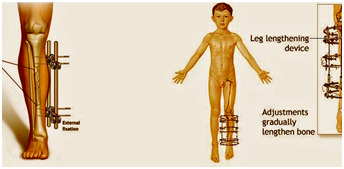
Limb shortening reduces the length of the longer limb after growth is complete.
In the case of a child with hemihypertrophy who has attained full growth, the longer limb is shortened to reduce the length of the longer leg.
The treating surgeon will remove a part of the bone from the middle of the long bone and join it together using metal rods or plates and screws to enable healing and joining.
Limb lengthening is performed on children with major discrepancies. This procedure is performed either internally or externally.
In external lengthening, the treating surgeon cuts the bone of the shorter leg and applies an external fixator to the leg using pins and/or wires.
This procedure begins after 5 days of the surgery and is done manually by either the patient or his or her caregiver.
By doing so, the bones grow distant slowly giving space for the new bone to grow leading to lengthening of the limb. The bone is likely to lengthen 1 mm each day which means nearly 1 inch in a single month.
The treating surgeon cuts the bone of the shorter leg to implant an expandable metal rod within it.
The rod is capable of lengthening as per the movement of the limbs of the patient.
Through this, the bones are gradually pulled away from each other enabling the bone to grow and fill up the void while the rod offers stability and alignment to the bone.
Internal lengthening uses an expandable rod to gradually increase bone length and maintain alignment.
For the best outcomes of both these procedures, the child has to undergo physical therapy and home exercise along with regular check-ups with the treating surgeon.
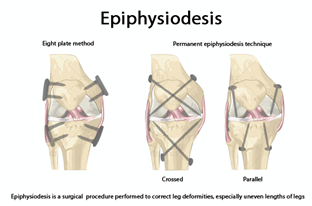
Epiphysiodesis is a surgical procedure to stop or slow down the growth of the longer leg and enable the shorter leg to grow normally.
It is performed in either of two ways. The growth plate is prevented from growing further either through drilling it or scraping it. This allows the opposite leg to grow and match the length of the normal leg.
The growth of the growth plate is prevented by placing metal staples or a plate with screws on its sides.
These staples are removed once the discrepancy of the length is resolved and both legs attain the same length.
Timing plays a crucial role in performing this procedure. The treating surgeon ensures that the equality in leg length is achieved by the time the child stops growing so the ideal age would be during mid-teens to later teenage years.
However, six-monthly checkups are essential to monitor the growth of the limbs and offer customized solutions to treat and manage limb length discrepancies.
Children with hemihypertrophy can grow and lead normal lives with normal intelligence.
Most of them experience normal growth and with reduced risk of cancer by the time they reach adolescence.
However, it is advisable to resolve leg length differences and other abnormalities through corrective surgery.