Are you suffering from unbearable shoulder pain for a couple of days or a week or so?
Is there bruising or swelling or feeling pins and needles sensation all over the arm and fingers too?
Well, then it's best to approach a sports injuries doctor to diagnose if it is a shoulder dislocation condition.
Dr. Ratnav Ratan, the best orthopedic doctor in Gurgaon, is available for consultation and treatment of sports-related injuries.
Shoulder dislocations are common in sportsmen in particular, especially those involved in playing hockey, football, skiing, and even gymnastics. Falls, car accidents, and seizures can also lead to dislocation of the shoulder.
The shoulder joint is known to be the most mobile joint of the body. This joint is composed of the joint capsule and ring of tendons, i.e., the rotator cuff, along with a network of tendons, ligaments, and muscles.
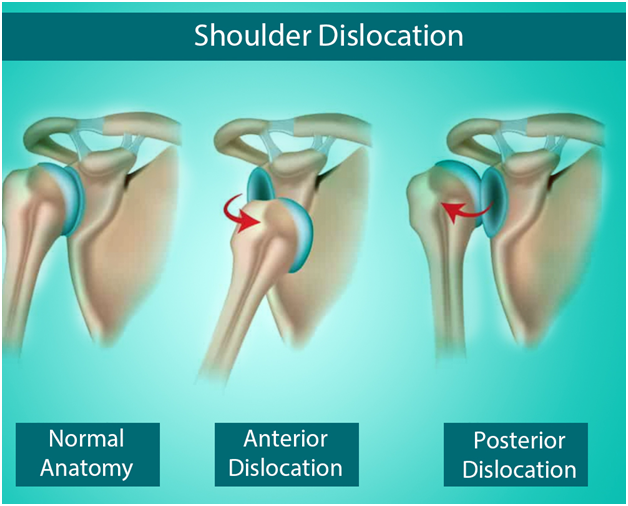
Normal anatomy, anterior dislocation, and posterior dislocation
It is very likely that the shoulder joint gets dislocated due to trauma force, especially in the forward direction. However, the intensity of the impact determines the damage in the surrounding ligaments, muscles, and tendons.
If all the damaged ligaments, muscles, and tendons cannot be repaired through a primary non-surgical approach, then the shoulder dislocation will require surgical treatment.
Dr. Ratnav Ratan is a dedicated sports injuries doctor in Gurgaon who ensures total recovery and back to sports action of his patients. He is an expert in treating shoulder dislocation cases and will suggest a suitable treatment for putting the shoulder back to its original location.
He will check for repetitive overhead movement, history of previous dislocation, and even genetic factors responsible for the shoulder dislocation. Repetitive dislocations lead to shoulder instability.
First, he will assess the situation and conduct a physical examination of the dislocated shoulder along with X-rays and other imaging tests, if required.
Initially, the treating orthopedic surgeon will recommend:
In case there is no improvement in the condition of the patient or shoulder instability, then the surgeon will recommend surgical treatments to work on the torn or stretched muscles and ligaments. The focus will be to repair and enable them to accommodate the shoulder joint properly.
Bankart repair is performed to repair anterior dislocations of the shoulder, which occur towards the front side of the body. The dislocation creates a tear in the labrum, which is the cartilage around the shoulder’s socket; this tear is called a Bankart lesion. The surgeon will perform a Bankart repair, treat the torn cartilage, and re-position it to the shoulder’s socket.
Latarjet procedure is performed on a patient with a bone loss in the dislocated shoulder socket. The surgeon will use bone material from either the shoulder blade area or the iliac crest or from a donor and repair the frontal area of the shoulder’s socket.
The surgeon will recommend a Remplissage procedure if the shoulder’s ball needs repair due to dislocation. This condition is known as a Hill Sachs lesion. The surgeon will work on the head and resurface it. Further, the surgeon will fix the shoulder’s ball to the rotator cuff.
The surgeon will recommend a capsular shift procedure if the patient has a natural joint laxity condition. This procedure involves tightening the ligaments that surround the shoulder, which has loosened due to recurring dislocations. It is also performed on patients who have shoulder instability conditions.
The recovery period primarily depends upon the type of procedure performed, i.e., either open surgery or through an arthroscopy. During the recovery period, the patient will have to embark upon an extensive physical therapy and rehabilitation schedule.
Patients who have both managed through an arthroscopy are likely to recover sooner. In the initial two weeks, the patient will have to wear a sling and restrict shoulder movements as much as possible.
After two weeks, the surgeon will recommend physical therapy to strengthen the shoulder muscles and improve the functioning of the shoulder. The intensity of physical therapy will gradually increase, and after six weeks of the shoulder dislocation procedure, there will be a considerable improvement.
Post-six weeks of the procedure, the patient will be comfortably able to perform daily tasks and resume professional duties. However, sportspersons need to check with their sports injury doctors regarding returning to their preferred sports activities.