

Frozen shoulder (also called adhesive capsulitis) is a condition in which the shoulder is painful, stiff, and has restricted motion in every direction.
Frozen shoulder exercises are often the foundation of treating frozen shoulder. Before starting any exercises for frozen shoulder, one must remember to warm their shoulder up.
The right method is to have a warm bath or shower for ten to fifteen minutes. A person can also use a moist heating pad, or a damp towel heated inside the microwave, but this may not be effective.
According to an orthopedist in Gurgaon, while doing the frozen shoulder exercises mentioned below, stretch till the tension point but not the pain point.
Pendulum stretch

- Relax the shoulders, stand and lean over slightly, making the affected hand hang down.
- After that, swing the arm in a small circle — about a foot in diameter.
- Make ten revolutions in every direction, once in a day.
As symptoms get better, raise the diameter of the swing; however, do not force it. When a person is ready for more, they can hold a lightweight (three to five pounds) in the swinging arm to increase the stretch.
Towel stretch

- Grab one end of a three-foot-long towel behind the back and hold the opposite end with the other hand.
- Grab the towel in a horizontal position.
- With the good hand, pull the affected hand upward to stretch it.
One can also perform an advanced version of this exercise with the towel draped on their good shoulder.
- Grab the towel’s end with the affected hand and pull it to the lower back with the unaffected hand.
- Do this exercise ten to twenty times a day.
Finger walk

- Begin by facing wall three-quarters of an arm’s length away.
- One should reach out and touch the wall at waist level with the fingertips of their affected arm.
- Using the elbow slightly bent, slowly walk the fingers up the wall, spider-like, till the fingers have raised the hand as far as one can go comfortably.
- The fingers must be working, not the shoulder muscles.
- Slowly lower the arm (using the good arm, if required) and repeat.
- Do this exercise ten to twenty times a day.
Cross-body reach

- Do this exercise while standing or sitting.
- With the good hand, lift the affected hand at the elbow.
- Bring it up and across the body, exert gentle pressure to stretch the shoulder.
- Hold the stretch for fifteen to twenty seconds.
- Perform this exercise ten to twenty times per day.
Armpit stretch
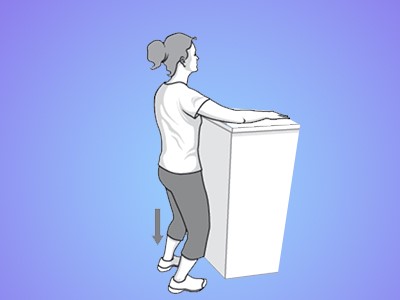
- Use the good arm to lift the affected arm onto a shelf which is at the breast’s height.
- Gently bend the knees, open the armpit.
- Deepen the knee bend slightly, gently stretching the armpit, and then straighten.
- Using more knee bend, stretch a bit more, but do not force it.
- Do this exercise ten to twenty times every day.
Starting to strengthen
As the range of motion enhances, add rotator cuff–strengthening exercises. Ensure to warm up the shoulder and perform stretching exercises before strengthening exercises.
Outward rotation
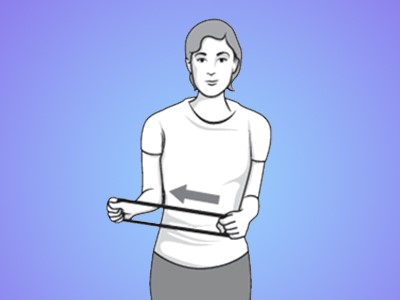
- Grab a rubber exercise band between the arms with the elbows at a ninety-degree angle close to the sides.
- Rotate the lower area of the affected arm outward two or three inches, hold for five seconds.
- Repeat ten to fifteen times a day.
Inward rotation

- Stand near a closed door, and hook one end of a rubber exercise band around the doorknob.
- Grab the other end with the affected arm’s hand, keeping the elbow at a ninety-degree angle.
- Pull the band towards the body two or three inches and hold it for five seconds.
- Repeat ten to fifteen times a day.
Wall climb stretch

- Stand facing towards a wall, with the hand of the affected arm against the wall.
- Slide the hand and arm up the wall as far as possible without any pain.
- Move the body closer to the wall to stretch higher up the wall.
- Hold the stretch for fifteen to twenty seconds.
- Repeat the stretch ten times.
Forward flexion

A person can use a passive range of motion, where they or some other person gently pulls on the affected arm to stretch it.
- Lie on the back with legs resting comfortably.
- Bend the “good” arm across the body to lift the affected arm toward the ceiling till one feels a gentle stretch.
- Hold the position for fifteen seconds, and then slowly lower the affected arm down.
- Repeat as one becomes stronger and raise the hold time.
Routine stretching, physical therapy, and exercises are helpful in both the short term and long term. They can help decrease pain and increase the range of motion in the frozen shoulder.
It is a good idea to consult an orthopedic specialist when beginning a stretching program and home exercise. A specialist can help one understand their frozen shoulder stage and which exercise would best suit their condition.